
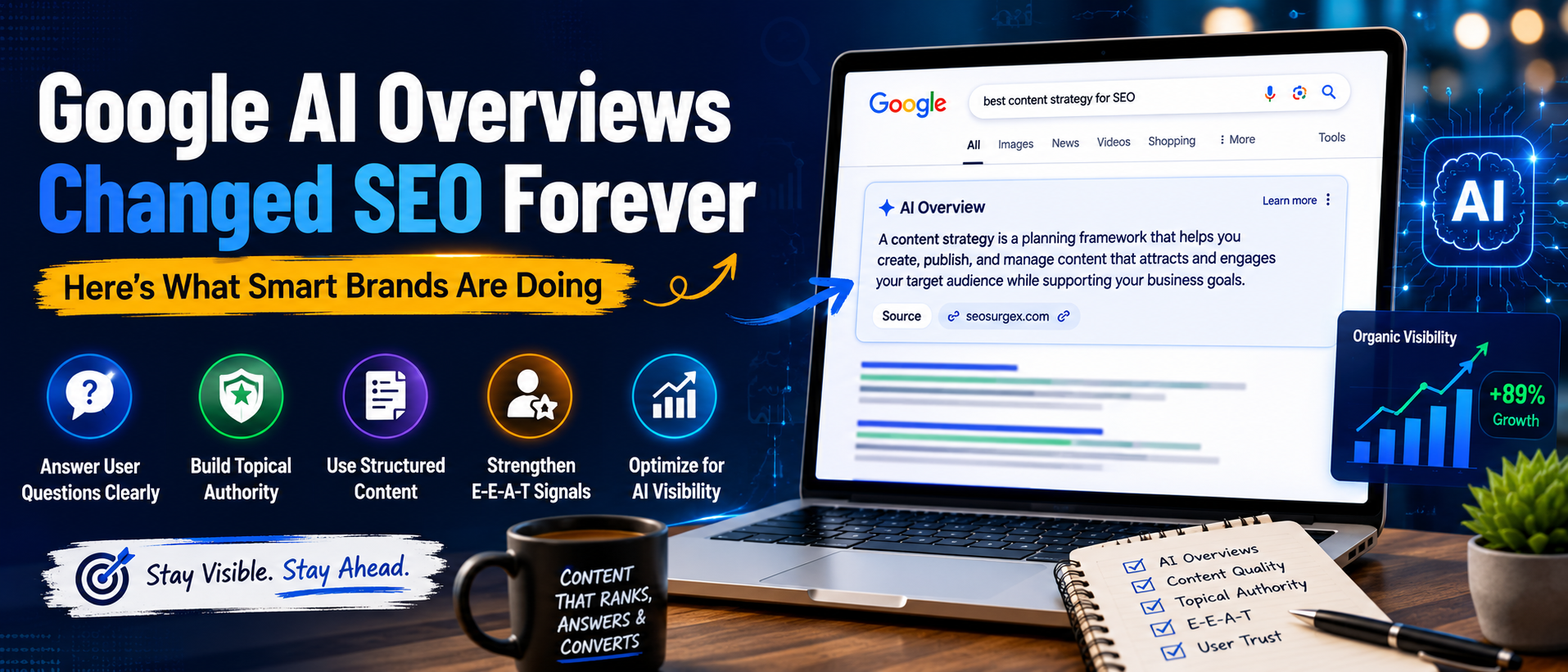
Search changed. Not gradually. Not quietly. Google flipped the switch on Google AI Overviews, and suddenly the top of the search results page looks nothing like it did two years ago.
If you’ve noticed your organic traffic dipping even when you’re ranking on page one, you’re not imagining it. The SEO landscape has fundamentally shifted, and the brands that understand this are already pulling ahead.
Let’s break down what actually happened, why it matters, and what you should do right now.
What Are Google AI Overviews, Exactly?
When someone types a question into Google search today, they often see a big AI-generated summary sitting right at the top of the page before any blue links appear. That’s Google AI Overview — Google’s way of answering questions directly using its Gemini AI model.
The goal from Google’s side is simple: give users the answer without making them click around. Great for users. Complicated for brands and publishers.
Here’s the thing though. Those AI answers pull from somewhere. Google isn’t making them up. It’s sourcing, synthesizing, and crediting content from websites it considers trustworthy and relevant. That’s your opening.
How Google AI Search Is Changing Click Behavior
The old game was ranking in the top three. Get there, get clicks. That’s still true, but the rules around it changed.
With Google AI search now presenting summarized answers upfront, users scan the AI block first. If the answer satisfies them, they don’t click at all. This is what SEO people call “zero-click searches,” and it’s growing.
But here’s what most brands miss: if your content gets cited inside the AI Overview box, you still win. You get visibility, brand exposure, and often a direct link to your page. In some cases, being featured in the AI Overview drives more qualified traffic than a standard position-three ranking ever did.
The smart move isn’t to fight this shift. It’s to understand how Google AI overview optimization actually works and use it deliberately.
What Smart Brands Are Doing Differently
Brands that are thriving right now in Google AI Overviews SEO are doing a few things consistently.
They write to answer, not just to rank. Content that gets pulled into AI Overviews tends to answer specific questions clearly and directly. No fluff. No burying the answer in paragraph five. If someone asks “how does X work,” the answer is in the first two sentences. Then you expand.
They build genuine topical authority. Google’s AI pulls from sources it trusts. If your site covers a topic thoroughly, consistently, and accurately, you become a go-to source. This means clusters of related content, not just one-off articles. Our SEO packages are built around this exact approach — helping businesses build real authority, not just chase keywords.
They optimize for structured content. Headers, bullet points, numbered lists, concise definitions — these formats make it easier for Google’s AI to extract and summarize your content accurately. Think of it as writing for a very smart reader who’s also in a hurry.
They focus on E-E-A-T harder than ever. Experience, Expertise, Authoritativeness, Trustworthiness. Google’s AI leans heavily on these signals when deciding which content to include in an Overview. Author bios, original research, case studies, and real-world examples all help signal that your content comes from someone who actually knows what they’re talking about.
Even competitive industries like online gaming – platforms like EK1 game have mastered topical clustering to dominate their niche search results. We’ve seen it work for e-commerce brands, local service businesses, and B2B companies alike.
Google AI Overview Optimization: The Tactical Side
Beyond content quality, there are specific technical and strategic moves that help with Google AI overview optimization.
Use clear question-and-answer formatting. If a common search query in your industry is a question, address it explicitly with that exact question as a subheading. Google’s AI is much more likely to surface content that directly mirrors the search query structure.
Keep your definitions sharp. AI Overviews love clean, authoritative definitions. If you define industry terms clearly and early in your content, you increase the chance of being cited.
Get your schema markup right. FAQ schema, How-To schema, and Article schema all give Google cleaner signals about what your content contains. This is a small technical effort with a meaningful payoff in AI visibility.
Earn links from credible sources. Yes, backlinks still matter. When credible sites like have higher Domain Ratings or other established platforms link to your content, it reinforces your authority signals.
Your Google AI SEO Strategy Going Forward
Here’s the honest reality. Google AI SEO strategy isn’t a one-time fix. It’s an ongoing commitment to creating content that genuinely serves your audience better than anyone else does.
The brands losing traffic right now are the ones that built their strategy around keyword stuffing, thin content, and volume over quality. The ones gaining ground treat every piece of content as a chance to become the best possible resource on that topic.
A few things worth doing this month:
Start auditing your top-performing content and ask whether it answers questions clearly in the first paragraph. Update any pages that bury the key information too deep. Add structured formatting where it’s missing. Make sure your digital marketing strategy includes a content refresh cycle, not just new post creation.
Also check how you appear in Google AI search results right now. Search your core topics and see if competitors are getting cited in the AI Overview box while you’re not. That gap is fixable, but only if you know it exists.
The Bottom Line
Google AI Overviews aren’t going away. If anything, they’re going to become more prominent and more influential over the next 12 to 24 months. Brands that treat this as a threat will keep losing. Brands that treat it as a targeting opportunity will find themselves in front of more of the right people.
The question isn’t whether Google AI overview SEO matters for your business. It clearly does. The question is whether you’re going to adapt your content strategy to match how search actually works today, or keep optimizing for a version of Google that no longer exists.
If you want help building a content and SEO strategy that’s designed for where search is heading, not where it’s been, our team is ready to dig in. Explore our work, check out SEO Work for design inspiration on presenting your content, and let’s build something that lasts.
Need an SEO strategy that actually keeps up with Google?