
How to Do Keyword Research for Medicine & Health Websites

How to Do Keyword Research for Medicine & Health Websites

Keyword research is one of the most important parts of SEO for medicine and health websites. Unlike many other industries, healthcare SEO requires more than finding keywords with high search volume. Health-related searches can influence important decisions, so websites need to understand search intent, provide trustworthy information, and create content that answers questions accurately.

A strong healthcare keyword strategy helps medical websites attract relevant visitors while building topical authority. Whether you manage a pharmacy website, medical clinic, health blog, healthcare platform, or online medical resource, the right keywords can help your content reach people at the exact moment they are looking for reliable information.

This guide explains how to perform keyword research for medicine and health websites, how to understand healthcare search intent, and how to build a content strategy around your findings.

Understand the Difference Between Healthcare Keywords and General Keywords

Healthcare searches are often more sensitive than searches in industries such as fashion, travel, or entertainment. People may search for symptoms, treatments, medications, side effects, dosage information, medical conditions, or healthcare providers.

For example, someone searching for “headache causes” may be looking for general educational information. Someone searching for “migraine treatment” may want to understand available treatment options. A query involving a specific medicine may indicate that the person wants information about its uses, safety, availability, or prescription requirements.

This means keyword research should consider both search volume and the reason behind the search.

A keyword with 10,000 monthly searches is not automatically more valuable than a keyword with 500 searches. A lower-volume query may have much stronger relevance to the website’s audience and business objectives.

Start With Your Healthcare Website’s Main Topics

Before using keyword research tools, identify the main subjects your website covers.

For a pharmacy website, these may include medicines, prescription requirements, medication information, treatment categories, health conditions, and patient education.

For a medical clinic, the topics could include treatments, symptoms, procedures, specialties, doctors, conditions, and frequently asked patient questions.

For a health information website, you may focus on diseases, symptoms, prevention, nutrition, medications, wellness, and medical research.

Create broad topic groups first. These groups become the foundation for your keyword research.

For example, a cardiovascular website could have topic groups such as:

  • Heart health
  • High blood pressure
  • Cholesterol
  • Heart disease
  • Lifestyle and prevention
  • Heart medications

Each broad topic can then be expanded into hundreds of more specific search queries.

Focus on Search Intent

Search intent tells you what a person expects to find after searching for a particular keyword.

Healthcare keywords generally fall into several major intent categories.

Informational searches are used when someone wants to learn something. Examples include “what causes high blood pressure,” “amoxicillin side effects,” or “how long does a migraine last.”

Commercial research searches happen when people are comparing potential solutions. Examples include “different treatments for erectile dysfunction” or “antibiotics used for bacterial infections.”

Transactional searches indicate that the person is trying to take an action. Medicine-related transactional queries can include searches for pharmacies, prescriptions, appointments, or medication availability.

Navigational searches are used when someone is looking for a particular healthcare organization, pharmacy, hospital, or medical brand.

Understanding these differences helps you create the right content for each keyword instead of trying to rank every keyword with a generic blog post.

Use Long-Tail Healthcare Keywords

Long-tail keywords are usually more specific than broad keywords. They often have lower search volume but can provide valuable information about what users actually want.

Instead of targeting only “amoxicillin,” a healthcare website could research phrases such as “what is amoxicillin used for,” “amoxicillin common side effects,” “how is amoxicillin prescribed,” or “when should amoxicillin be taken.”

Similarly, instead of targeting only “Viagra,” a website could investigate informational searches about how sildenafil works, possible side effects, interactions, prescription requirements, and differences between erectile dysfunction treatments.

Long-tail keywords can also reveal questions that deserve dedicated FAQ sections.

Research Medication-Related Keywords Carefully

Medication keywords require additional attention because users may search for specific products, dosages, or purchasing options.

For example, searches involving phrases such as “kamagra oral jelly” may represent different intentions. One person could be looking for general information about the medicine, while another could be searching for availability or purchasing options.

Your keyword research should therefore separate informational queries from potentially transactional queries.

The same principle applies to searches such as “order amoxicillin.” Rather than simply targeting the phrase with promotional content, a responsible healthcare website can create useful information explaining prescription requirements, appropriate medical use, antibiotic resistance, and why antibiotics should only be taken when medically appropriate.

This approach gives the website an opportunity to rank for relevant searches while providing information that protects users from inappropriate self-medication.

Research Location-Based Healthcare Keywords

Location can significantly change healthcare search intent.

People frequently search for medical services using geographic terms such as city names, neighborhoods, countries, or regions.

Examples include:

“dentist in Ahmedabad”

“dermatologist in Mumbai”

“pharmacy in Malta”

“private clinic in London”

“emergency dentist near me”

Location-specific keyword research can help clinics and healthcare businesses attract people who are actually able to use their services.

For pharmaceutical-related searches, location also matters because medicine regulations, prescription requirements, pharmacy rules, and availability can vary between countries.

A query such as “viagra online malta” should therefore be treated carefully. Content targeting such a query should explain the importance of using legitimate, legally operating pharmacies and obtaining appropriate medical advice rather than encouraging users to purchase medicines from unknown sources.

Analyze Competitor Healthcare Websites

Competitor research can reveal valuable keyword opportunities.

Start by identifying websites that rank for the healthcare topics you want to cover. Look at their major categories, blog topics, FAQs, treatment pages, medication guides, and informational resources.

Pay particular attention to pages that consistently appear in search results for multiple related queries. These pages may indicate strong topical coverage.

However, don’t simply copy competitor topics. Look for missing information, unanswered questions, outdated explanations, and opportunities to provide clearer or more useful content.

Healthcare SEO should focus on improving information quality rather than producing another version of the same article.

Build Keyword Clusters

Instead of creating one page for every keyword variation, organize related keywords into clusters.

For example, a medication information cluster might include:

What is the medicine used for?

How does it work?

Who should avoid it?

What are the common side effects?

What are serious side effects?

What medicines can interact with it?

How is it normally prescribed?

When should someone speak with a doctor?

These questions can be organized into one comprehensive resource when the search intent is closely related.

Keyword clustering prevents keyword cannibalization and helps search engines understand the website’s topical relationships.

Consider Healthcare Authority and Trust

Healthcare websites need particularly strong trust signals.

Content should identify its author where appropriate and make it clear when medical information has been reviewed by a qualified healthcare professional.

Citations to reputable medical and government sources can also strengthen informational content. Depending on the subject, useful sources may include national health authorities, medical associations, academic institutions, and peer-reviewed research.

Avoid making unsupported claims such as “this medicine is completely safe” or “this treatment works for everyone.”

Instead, explain what is known, identify relevant limitations, and encourage readers to consult an appropriate healthcare professional when individual medical advice is required.

Use Keyword Tools, But Don’t Depend Only on Search Volume

Popular SEO tools can provide useful data such as search volume, keyword variations, competition, trends, and related searches.

However, healthcare keyword research should combine tool data with actual search-result analysis.

Search the keyword and examine what Google displays. Are the results medical organizations, hospitals, pharmacies, research institutions, forums, news websites, or commercial stores?

The results provide important clues about the dominant search intent.

If most results are detailed educational resources, creating a purely commercial landing page may not satisfy the search intent. Likewise, if users are searching for a local clinic, a general health article may not be the right page to target that query.

Create a Healthcare Keyword Map

Once your research is complete, create a keyword map that connects keywords with specific website pages.

For example:

A condition page can target the primary disease or condition keyword.

A treatment page can target treatment-related searches.

A medication guide can target medication information queries.

A blog article can answer a specific patient question.

A location page can target local healthcare searches.

An FAQ section can target closely related long-tail questions.

This structure helps prevent multiple pages from competing against one another for the same search terms.

Monitor Rankings and Search Behavior

Keyword research does not end when your content is published.

Monitor ranking changes, impressions, clicks, click-through rates, and conversions through tools such as Google Search Console and your preferred SEO platform.

Look for queries where your pages receive impressions but have relatively low rankings. These can reveal opportunities for improving titles, headings, internal links, supporting information, and content depth.

Also monitor new queries that begin generating impressions. Sometimes Google will show a page for related searches that were not part of the original keyword research. These queries can reveal new content opportunities.

Avoid Keyword Stuffing

Healthcare content should never be written simply to repeat keywords.

Using a medicine name excessively can make an article difficult to read and may reduce its usefulness. Search engines are increasingly capable of understanding topics through related terms, entities, context, and natural language.

Use the primary keyword where it makes sense, then naturally incorporate related concepts and questions.

The goal should be to create the most useful page for the reader rather than achieving an arbitrary keyword density.

Build Content Around Real Patient Questions

One of the most effective ways to find healthcare keywords is to listen to the questions people actually ask.

Review Google autocomplete suggestions, related searches, Search Console queries, patient FAQs, customer-service questions, medical forums, and discussions around relevant healthcare topics.

Questions such as “How long does this medicine take to work?” or “Can this medication interact with another medicine?” may become valuable content opportunities.

When these questions are answered clearly and responsibly, the resulting content can attract users at different stages of their research journey.

Final Thoughts

Keyword research for medicine and health websites requires a combination of SEO research, search-intent analysis, topical organization, and responsible healthcare communication.

Start with broad medical topics, expand them into specific keyword groups, analyze search intent, research long-tail questions, study competitors, and organize related queries into useful content clusters.

Most importantly, remember that healthcare SEO is not only about attracting visitors. The content needs to help people understand health information safely and accurately.

A strong healthcare keyword strategy therefore combines search visibility with trustworthy content. When your website consistently answers relevant questions with clear, well-supported information, you can build a stronger organic presence while creating a better experience for people searching for health information online.
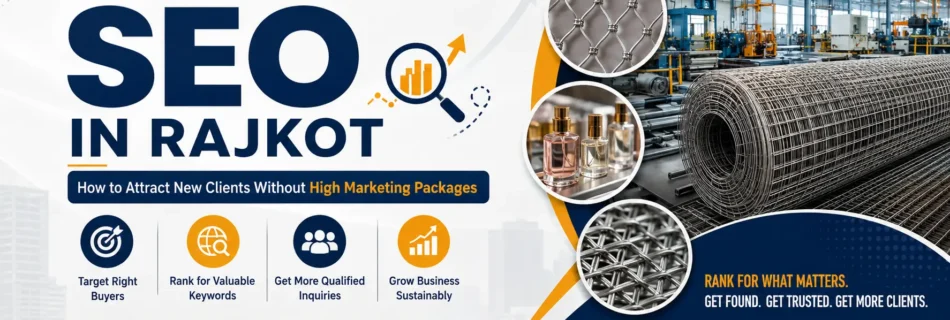
Local Manufacturing Business SEO in Rajkot: How to Attract New Clients Without Expensive Marketing Packages

Local Manufacturing Business SEO in Rajkot: How to Attract New Clients Without Expensive Marketing Packages

Rajkot is known for engineering, auto components, casting, CNC machining, hardware, wire products, pumps, industrial equipment and many other manufacturing businesses. Thousands of manufacturers operate in and around the city’s industrial areas, but having a good factory, experienced workers and quality products is no longer enough.

Today, your potential buyer may discover your company on Google before calling your sales team.

A procurement manager searching for “SS wire mesh manufacturer”, an importer looking for an OEM perfume manufacturer in India, or a business owner searching for “SS net jali” may compare several suppliers online before sending an inquiry.

This is where Search Engine Optimization, or SEO, can make a major difference.

For a manufacturing company, SEO is not simply about getting website visitors. The real objective is to appear when potential buyers are actively searching for your products, capabilities and manufacturing services.

At SEO SurgeX, we focus on search visibility that can contribute to real business growth: better rankings, relevant traffic, qualified inquiries and stronger brand visibility. Our website highlights SEO, local SEO, international SEO, Google Ads and manufacturer-focused SEO as part of our digital marketing capabilities.

Why Manufacturing Businesses in Rajkot Need SEO

Many Rajkot manufacturers still depend heavily on traditional sales methods.

They rely on:

  • IndiaMART and TradeIndia
  • Sales representatives
  • Existing distributors
  • Referrals
  • WhatsApp inquiries
  • Exhibitions and trade fairs
  • Cold calling
  • Existing customer networks

These methods can work, but they also have limitations.

You may have to continuously pay for advertising packages, contact prospects manually or depend on existing relationships.

SEO works differently.

When your website ranks for a valuable commercial keyword, buyers can discover your business organically while they are already searching for a product or supplier.

For example, imagine a buyer searches:

“SS wire mesh manufacturer India”

Your website appears on the first page.

EK1 APP

The buyer visits your product page, checks specifications, reviews your manufacturing capabilities and sends an inquiry.

That is a very different visitor from someone who randomly lands on your website.

The person already has a requirement.

SEO Can Turn Your Website Into a 24/7 Sales Channel

A properly optimized manufacturing website can work even when your sales team is not calling prospects.

Your website can explain:

  • What you manufacture
  • Where you manufacture
  • Industries you serve
  • Product specifications
  • Available sizes
  • Materials
  • Manufacturing capabilities
  • Quality standards
  • Delivery locations
  • Export capabilities
  • Frequently asked questions
  • How customers can request a quotation

This creates a digital sales asset that continues working after the SEO campaign has been implemented.

The Biggest SEO Mistake Manufacturers Make

One of the biggest mistakes we see across manufacturing websites is creating a website that talks about the company but does not target the searches buyers actually make.

A typical website may say:

“We are a leading manufacturer providing high-quality products with advanced technology and customer satisfaction.”

That sounds professional.

But it does not necessarily answer what Google or your customer needs to know.

A buyer may instead search:

SS Wire Mesh Manufacturer in India

SS Net Jali Manufacturer

Stainless Steel Wire Mesh Supplier

OEM Perfume Manufacturer India

Industrial Wire Mesh Supplier

Wire Mesh Manufacturer in Rajkot

These are commercial searches.

Your website needs dedicated pages that match these specific requirements.

Real SEO Ranking Examples From SEO SurgeX Clients

At SEO SurgeX, we have worked on SEO campaigns targeting highly specific commercial keywords.

Some examples of keywords our clients have achieved rankings for include:

1. SS Net Jali

“SS net jali” is a highly product-focused search.

Someone searching this phrase is unlikely to be looking for general information about stainless steel.

They are likely looking for a supplier, manufacturer, product specification or quotation.

Ranking for this type of keyword can therefore bring highly relevant visitors to a manufacturer’s website.

2. OEM Perfume Manufacturer India

International buyers often search for manufacturers using terms such as:

“OEM perfume manufacturer India”

This type of keyword demonstrates why manufacturers should not limit SEO to Rajkot.

A Rajkot company can have its manufacturing facility in Gujarat while targeting buyers throughout India and overseas.

A properly structured international SEO strategy can help manufacturers reach distributors, importers, private-label brands and wholesalers searching from different markets.

3. SS Wire Mesh

“SS wire mesh” is another product-focused keyword where search visibility can put a manufacturer in front of potential buyers.

The important lesson is that manufacturers should not focus only on keywords such as “best manufacturer” or “industrial company.”

Product keywords can be much closer to the purchasing stage.

4. Kamagra Ireland

A ranking such as “kamagra ireland” demonstrates another important SEO principle: search intent and geographic targeting can create opportunities beyond a company’s immediate physical location.

For manufacturing and export businesses, the same principle applies to legitimate industrial products.

Instead of thinking only:

“How can I get customers in Rajkot?”

Think:

“Which markets are searching for my product, and how can my website reach them?”

How SEO Creates Real Business Growth

SEO can impact a manufacturing business at several levels.

More Visibility

Your company becomes easier to discover when buyers search for your products.

More Qualified Traffic

Instead of attracting random visitors, you can target keywords related directly to your products and services.

More Inquiries

A strong product page can encourage visitors to call, WhatsApp, email or request a quotation.

Lower Dependence on Paid Advertising

Organic rankings can reduce your dependence on continuously paying for every visitor.

Stronger Brand Credibility

When buyers repeatedly see your company in Google results, your brand can become more familiar and trustworthy.

Wider Geographic Reach

A Rajkot manufacturer can target Ahmedabad, Mumbai, Delhi, Pune, Surat, Bengaluru, Hyderabad and other Indian markets, as well as international buyers.

Local SEO for Rajkot Manufacturers

Local SEO is particularly useful for manufacturers that want customers and distributors from Rajkot and nearby industrial markets.

Your Google Business Profile should accurately represent your company, location, contact information, services and manufacturing capabilities.

Your website should also clearly mention relevant geographic areas naturally.

For example:

Wire Mesh Manufacturer in Rajkot

Industrial Product Manufacturer in Gujarat

SS Wire Mesh Supplier in Rajkot

Engineering Component Manufacturer in Gujarat

However, avoid creating dozens of low-quality city pages simply by changing the city name.

Each location page should provide genuinely useful information about the market, delivery area, capabilities or services.

Current manufacturing SEO guidance also emphasizes detailed product pages, local search optimization, Google Business Profile improvements and industry authority signals as important parts of a manufacturer’s search strategy.

Google Business Profile Can Help Local Manufacturers

Many manufacturers think Google Business Profile is only useful for restaurants, doctors or retail shops.

That is not true.

A manufacturing company with a legitimate business location can use its profile to strengthen local visibility.

Your profile should include accurate:

Business name

Category

Address

Phone number

Website

Business hours

Factory photographs

Product photographs

Team photographs

Updates

Customer reviews

The objective is not to stuff keywords into your business name.

The objective is to provide Google and potential customers with accurate information about your company.

Local SEO guidance for manufacturers also recommends using authentic factory photographs, relevant categories, service areas and customer reviews to strengthen local visibility.

Build a Separate SEO Page for Every Important Product

This is one of the most important strategies for manufacturing companies.

Do not put every product on one page.

Instead, create dedicated pages.

For example, a wire mesh manufacturer could have:

Stainless Steel Wire Mesh

A detailed page explaining materials, mesh sizes, applications, manufacturing process and industries served.

SS Net Jali

A dedicated page targeting the specific product terminology buyers use.

Industrial Wire Mesh

A page focused on industrial applications and technical requirements.

SS Wire Mesh Supplier

A commercial page designed around procurement and supply requirements.

Wire Mesh Manufacturer in Rajkot

A locally optimized page explaining manufacturing capabilities and service coverage.

This structure gives every page a clear purpose.

It also allows SEO to target multiple search intents instead of forcing dozens of keywords onto one page.

Your Product Pages Should Answer Buyer Questions

Manufacturing buyers often have technical questions before they contact a supplier.

Your website should answer them.

For example:

What material is used?

Explain available grades and materials.

What sizes are available?

Provide dimensions, mesh specifications and customization options where applicable.

What industries use the product?

Mention relevant applications.

Can you manufacture customized products?

Explain customization capabilities.

What is your minimum order quantity?

Provide information where appropriate.

Do you supply outside Rajkot?

Explain your service and delivery areas.

Do you export?

If applicable, explain export markets and documentation capabilities.

How can I request a quotation?

Make the next step extremely clear.

This type of content is much more valuable than generic paragraphs written only to increase word count.

Don’t Chase Only High-Volume Keywords

A common mistake is targeting only keywords with large search volumes.

For manufacturers, a keyword with 100 searches per month can potentially be more valuable than a keyword with 10,000 searches if the smaller keyword comes from a serious buyer.

Consider the difference:

“wire mesh”

versus

“SS wire mesh manufacturer India”

The first is broad.

The second shows stronger commercial intent.

A good manufacturing SEO strategy therefore combines:

Product keywords + manufacturer keywords + supplier keywords + location keywords + application keywords + industry keywords + export keywords.

How to Attract Clients Without Expensive Marketing Packages

SEO does not have to begin with a huge marketing budget.

A manufacturer can start with a focused strategy.

Start With Your Highest-Value Products

Do not try to optimize 100 products immediately.

Choose your top 5–10 products based on:

  • Profit margin
  • Demand
  • Manufacturing capacity
  • Competition
  • Existing customer demand
  • Export potential
  • Search intent

Then build strong pages around those products.

Optimize Existing Assets

Before creating hundreds of new pages, improve what you already have.

Optimize:

Page titles

Meta descriptions

H1 headings

Product descriptions

Images and alt text

Internal links

URLs

Contact forms

WhatsApp buttons

Call-to-action sections

Page speed

Mobile experience

Technical SEO and well-structured product pages are repeatedly highlighted as foundational components of manufacturing SEO.

Create One Useful Article Every Month

You do not need to publish 30 articles every month.

One strong article can be more useful than ten weak articles.

For example:

How to Choose the Right SS Wire Mesh for Industrial Applications

SS Wire Mesh Grades and Their Applications

What Is SS Net Jali Used For?

How to Select an OEM Perfume Manufacturer in India

Industrial Wire Mesh Buying Guide for Procurement Managers

These articles can attract informational searches and internally link visitors toward your product and quotation pages.

Turn Website Visitors Into Leads

Getting traffic is only half the job.

The website must make it easy to contact you.

Every important product page should have a clear CTA such as:

Request a Quote

Get Product Pricing

Talk to Our Sales Team

WhatsApp Us

Request Product Catalogue

Send Your Requirement

Don’t hide your contact information at the bottom of the website.

A buyer who has found the right product should be able to contact your company immediately.

SEO + WhatsApp Is a Powerful Combination for Rajkot Manufacturers

Many Rajkot business owners communicate with customers through WhatsApp.

Use that behaviour to your advantage.

A potential customer lands on your website.

They read the product details.

They see your manufacturing photographs.

They check your specifications.

Then they click WhatsApp for Quote.

The journey becomes:

Google Search → Website → Product Page → Trust → WhatsApp → Sales Team → Quotation

That is how SEO becomes connected to real business development.

SEO Is Not Just About Rajkot

Rajkot should be your starting point if your business serves the local market.

But manufacturers should think bigger.

A strong SEO campaign can target:

Rajkot

Ahmedabad

Surat

Vadodara

Morbi

Jamnagar

Mumbai

Pune

Delhi

Bengaluru

Hyderabad

and other relevant markets.

For exporters, you can create country-specific strategies based on actual demand.

This is particularly important for companies manufacturing specialized products that can be shipped across India or internationally.

Build Authority Around Your Manufacturing Expertise

Google needs signals that your company is legitimate and relevant.

Manufacturers can strengthen their online authority by showcasing:

Factory photographs

Machinery

Production processes

Certifications

Quality control

Industry experience

Case studies

Customer testimonials

Product catalogues

Technical documentation

Trade exhibitions

Industry memberships

Press mentions

Relevant industry links

This content also helps potential buyers understand that they are dealing with a real manufacturer rather than a generic reseller.

Measure SEO by Leads, Not Just Rankings

Ranking reports are useful, but they should not be the final measurement.

Ask better questions.

How many relevant visitors came from Google?

How many contacted the company?

How many requested quotations?

How many became qualified leads?

How many quotations converted into orders?

Which products generated the most inquiries?

Which cities generated the best leads?

Which keywords generated business?

This approach changes SEO from a marketing expense into a measurable business investment.

SEO SurgeX states that its approach focuses on attracting the right customers and turning traffic into leads and sales rather than treating traffic as the only objective.

A Simple 90-Day SEO Plan for a Rajkot Manufacturer

Month 1: Build the Foundation

Start with a technical SEO audit.

Fix indexing problems.

Improve website speed and mobile usability.

Research commercial keywords.

Optimize the homepage.

Optimize your Google Business Profile.

Create or improve your main product pages.

Add clear enquiry and WhatsApp options.

Month 2: Build Search Visibility

Create dedicated product pages.

Publish useful manufacturing content.

Improve internal linking.

Add product photographs and technical information.

Build relevant business and industry citations.

Strengthen local SEO signals.

Start tracking rankings, traffic and inquiries.

Month 3: Focus on Growth

Identify keywords showing positive movement.

Improve pages ranking on positions 4–20.

Build relevant industry backlinks.

Create location and application content where justified.

Publish customer-focused case studies.

Improve conversion rates on high-traffic pages.

Review which keywords are producing genuine inquiries.

Then repeat the process.

SEO is not a one-time website project. It is an ongoing process of improving visibility, relevance, authority and conversion.

Why Affordable SEO Can Be Better Than a Large Marketing Package

Many small and medium-sized manufacturers hesitate to invest in digital marketing because they receive expensive packages filled with services they may not actually need.

You may not need:

Daily social media posts

Large advertising budgets

Influencer marketing

Expensive video campaigns

Dozens of generic blog posts

Instead, your first investment can focus on the activities most closely connected to customer acquisition.

That may include:

Technical SEO

Commercial keyword research

Product page optimization

Local SEO

Google Business Profile

Content marketing

Internal linking

Authority building

Conversion optimization

A focused SEO campaign can be scaled as results improve.

Why Rajkot Manufacturers Should Start Now

The digital competition among manufacturers is increasing.

Current industry research and SEO guidance indicate that manufacturers can gain opportunities by combining technical SEO, detailed product pages, local search visibility and authority building rather than relying only on generic company pages.

The opportunity is especially important for manufacturers because buyers increasingly research suppliers before making contact.

Your competitor does not necessarily need to have a better factory than you.

They only need to be easier to find.

If their website appears when your potential customer searches for your product, they get the first conversation.

Final Thoughts: Your Factory Deserves to Be Found

Rajkot has no shortage of capable manufacturers.

The real challenge is making sure buyers can discover those manufacturers when they are ready to purchase.

SEO gives manufacturing businesses a way to build long-term visibility without depending entirely on expensive advertising packages.

The goal is simple:

Get found by the right buyer.

Show them the right product.

Build trust.

Make contacting you easy.

Convert the inquiry into a business opportunity.

At SEO SurgeX, we believe manufacturing SEO should be connected to business outcomes—not just ranking reports.

Our approach combines SEO, local SEO, technical optimization, content strategy, Google Business Profile optimization and conversion-focused improvements to help businesses build sustainable online visibility. SEO SurgeX also publicly lists dedicated SEO support for manufacturers among its industry services.

If you are a manufacturer in Rajkot and your website is not generating consistent inquiries from Google, it may be time to stop asking, “How much will SEO cost?”

Instead, ask:

“How many potential customers are searching for my products every month—and how many of them are finding my competitors instead of me?”

That is where the real opportunity begins.

About SEO SurgeX

SEO SurgeX is an SEO and digital marketing agency serving businesses in India and international markets. The agency offers SEO, local SEO, eCommerce SEO, Google Ads, international SEO, analytics and manufacturer-focused SEO solutions.

Ready to attract more manufacturing clients from Google? Contact SEO SurgeX for a practical SEO strategy built around your products, target markets and business goals.

Frequently Asked Questions

Is SEO useful for manufacturing companies in Rajkot?

Yes. SEO can help manufacturers appear when potential customers search for specific products, suppliers, manufacturers and industrial services. The strategy should focus on commercial search intent rather than traffic alone.

How much does manufacturing SEO cost?

The cost depends on the number of products, competition, target locations, website condition and business goals. A manufacturer does not necessarily need a large marketing package. A focused campaign can begin with the highest-value products and keywords.

How long does manufacturing SEO take?

SEO timelines vary by website authority, competition, keyword difficulty and implementation speed. Lower-competition long-tail keywords may move faster, while competitive national and international terms generally require more time and authority.

Can a Rajkot manufacturer target customers outside Gujarat?

Absolutely. A manufacturer can target cities across India and, where appropriate, international markets using national and international SEO strategies.

Should manufacturers invest in Google Ads or SEO?

Both can be useful. Google Ads can provide immediate paid visibility, while SEO is designed to build organic visibility over time. The right mix depends on the company’s budget, competition and sales goals.

What keywords should manufacturers target?

Start with product, manufacturer, supplier, application, industry and location keywords. For example, SS wire mesh, SS net jali, wire mesh manufacturer in Rajkot and relevant national or international commercial searches.

Does Google Business Profile help manufacturers?

Yes. A properly maintained Google Business Profile can support local visibility and help potential customers find your location, contact information, website and business details.

How can a manufacturer generate leads from an SEO website?

Create strong product pages, provide technical information, display proof of manufacturing capabilities and make it easy for visitors to request quotations through forms, calls, email or WhatsApp.

Can small manufacturers compete with larger companies on Google?

Yes. Smaller companies can compete by targeting specific products, long-tail commercial keywords, local searches and specialized applications rather than trying to compete immediately for broad national keywords.

What is the biggest SEO opportunity for Rajkot manufacturers?

One major opportunity is creating highly relevant product and capability pages around the exact searches used by procurement teams and buyers, then supporting those pages with technical SEO, local visibility, useful content and relevant authority signals.